
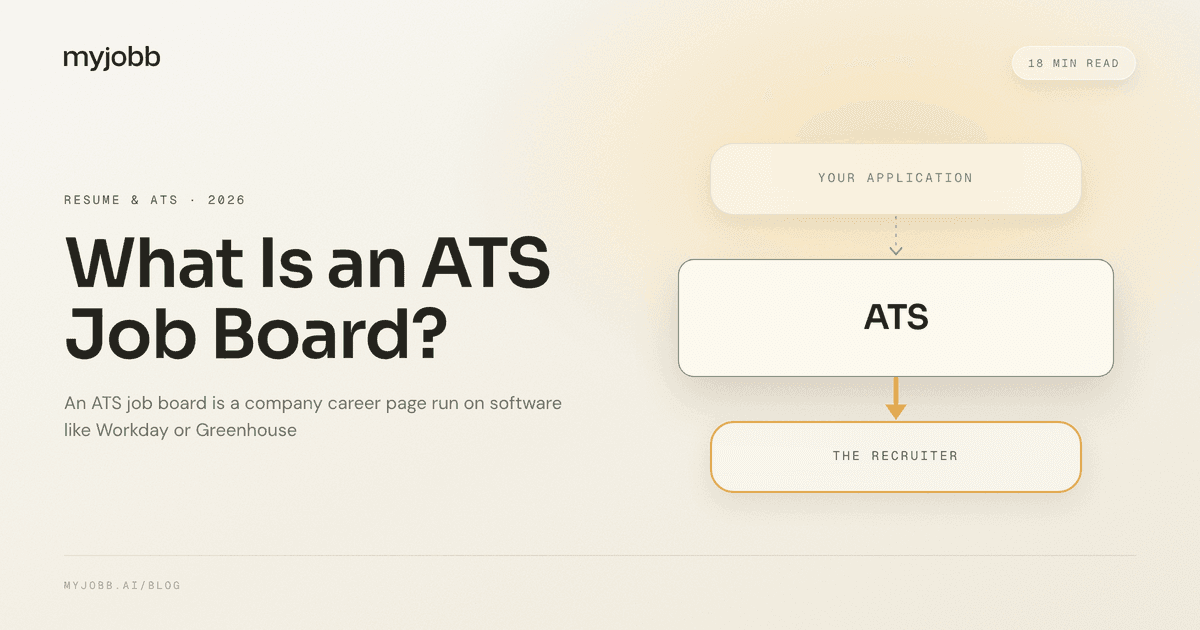
An ATS job board is the careers page a company runs on applicant tracking software such as Workday, Greenhouse or Lever. It sits on the employer's own domain, not on a job portal. You apply directly to the company, and your application lands inside that employer's hiring database.
myjobb is India's first AI job agent and a universal auto-apply agent: it applies to jobs on Naukri, Foundit, Hirist and Instahyre, and on company career pages running Workday, Greenhouse, Ashby, Lever, Oracle Recruiting, SuccessFactors, iCIMS and other major ATS platforms.
This page is the reference. It defines the terms, lists the major ATS platforms, and shows you how to identify any ATS from its URL in two seconds.
What is an ATS job board in simple terms?
An ATS job board is a company's own jobs page, hosted by recruiting software the company pays for. The software collects your application, parses your resume into fields, and ranks you against other applicants. The employer owns the data. No portal sits in the middle.
Think of it as the difference between a shop and a mall.
A job portal like Naukri is the mall. Thousands of employers rent space there. You browse listings from many companies in one place.
An ATS job board is the shop. It belongs to one employer. It shows only that employer's roles. The shelves, the till and the customer records all belong to that company.
The confusing part is the word "board." An ATS job board looks like a job board to you. It has search filters, location dropdowns and a list of open roles. Underneath, it is a hiring database that happens to expose a public front end.
What is the difference between a job board, an ATS, and a company career page?
A job board is a public marketplace where many employers post roles. An ATS is the software an employer uses to receive and manage applications. A company career page powered by an ATS is the public face of that software. You see a careers page. The recruiter sees a pipeline.
Here is the distinction in one table. This is the part most people get wrong.
- Examples. Job board: Naukri, Foundit, Hirist, Instahyre, Internshala · ATS: Workday, Greenhouse, Lever, Ashby, Darwinbox · Company career page on an ATS: careers.example.com powered by Greenhouse
- Who owns it. Job board: A media or marketplace company · ATS: A software vendor, licensed by the employer · Company career page on an ATS: The employer
- Who it is built for. Job board: Job seekers and recruiters searching for candidates · ATS: Recruiters and HR teams managing applications · Company career page on an ATS: Job seekers applying to one company
- How many companies. Job board: Thousands · ATS: One customer per instance · Company career page on an ATS: One
- What you do there. Job board: Search and apply across employers · ATS: Nothing. You never log into the employer's ATS · Company career page on an ATS: Apply to that company's open roles
- Where your resume goes. Job board: Into the portal's searchable database first · ATS: Into the employer's private candidate database · Company career page on an ATS: Into the employer's ATS
- Cost to the employer. Job board: Per job posting or subscription · ATS: Per seat or per employee, per year · Company career page on an ATS: Included with the ATS
- Do recruiters search it?. Job board: Yes. They buy resume database access · ATS: Yes, but only their own applicants · Company career page on an ATS: Yes, within their own pipeline
One more misconception worth killing. Naukri is not an ATS. Naukri is a job board with its own internal search and ranking engine. When you apply on Naukri, your profile is scored by Naukri's matching logic. Then, at many companies, it is exported into the employer's real ATS for screening. You pass through two systems, not one.
Which ATS platforms do companies use?
Most companies use one of about fifteen ATS platforms. Workday, Oracle Recruiting and SAP SuccessFactors dominate large enterprises. Greenhouse, Lever and Ashby dominate product companies and startups. Darwinbox, Keka and Zoho Recruit dominate Indian mid-market employers. Your application experience changes a lot depending on which one you hit.
This is the reference table. Save it.
- Workday. Who typically uses it: Large global enterprises, banks, retailers, pharma, GCCs · What the application experience is like: 5 to 8 screens. You create a candidate account per employer. The parser mangles your work history, so you retype it. Sessions time out. · Common in India?: Very common. Used at large IT services firms and most GCCs
- Greenhouse. Who typically uses it: Funded product and SaaS companies, Series A to IPO · What the application experience is like: One clean page. Resume upload, a few custom questions, done in 3 to 8 minutes · Common in India?: Common at Indian product startups and global SaaS firms hiring in India
- Ashby. Who typically uses it: Fast-scaling startups, often engineering-heavy · What the application experience is like: One page, modern UI. Conditional questions appear based on earlier answers · Common in India?: Growing fast among well-funded Indian and global startups
- Lever. Who typically uses it: Mid-size tech companies and scale-ups · What the application experience is like: One page. Short. Often asks for GitHub, portfolio or LinkedIn links · Common in India?: Common at tech companies with India engineering teams
- Oracle Recruiting (Taleo). Who typically uses it: Very large enterprises, consulting, telecom, manufacturing · What the application experience is like: 6 to 12 screens. Mandatory account, strict password rules, dated interface, hard timeouts · Common in India?: Very common at large Indian enterprises and legacy multinationals
- SAP SuccessFactors. Who typically uses it: Global enterprises already running SAP · What the application experience is like: 4 to 8 screens. Country-specific consent forms. Duplicate profile checks block re-applications · Common in India?: Common at manufacturing, FMCG, energy and large multinationals in India
- iCIMS. Who typically uses it: US-headquartered enterprises with global teams · What the application experience is like: 3 to 6 screens. Resume re-entry after parsing, plus add-on questionnaires · Common in India?: Present at multinationals with India operations
- BambooHR. Who typically uses it: Small companies, usually under 500 people · What the application experience is like: One short page. Questions vary a lot because teams are small · Common in India?: Less common. Mostly at small firms with US ties
- SmartRecruiters. Who typically uses it: Mid to large enterprises, retail and hospitality · What the application experience is like: One or two pages. Optional-looking fields that are actually knockout questions · Common in India?: Present at global consumer brands hiring in India
- Jobvite. Who typically uses it: US mid-market and enterprise employers · What the application experience is like: 3 to 5 screens. Dated UI, referral-source fields, sometimes forced account creation · Common in India?: Less common, mostly at US firms with India delivery centres
- Workable. Who typically uses it: SMBs and mid-market companies worldwide · What the application experience is like: One page, quick. Occasional short assessments bolted on · Common in India?: Moderately common at Indian SMBs and agencies
- Zoho Recruit. Who typically uses it: Indian SMBs, staffing agencies, consultancies · What the application experience is like: Short form, sometimes embedded on the company site itself · Common in India?: India-native. Very common at Indian SMBs and recruitment firms
- Darwinbox. Who typically uses it: Indian and Asian enterprises, 500 to 10,000 employees · What the application experience is like: Portal-style flow, mobile friendly, often ties into the company's HR suite · Common in India?: India-native. Strong in Indian banking, FMCG, IT and conglomerates
- Keka. Who typically uses it: Indian mid-market employers and growth-stage companies · What the application experience is like: Clean, short form. Often paired with the company's Keka HR portal · Common in India?: India-native. Very common at Indian mid-market firms
A note on how to read that table. Do not treat "common in India" as a ranking. Treat it as a probability. If you are applying to a GCC in Bengaluru, expect Workday. If you are applying to a Series B SaaS company in Bengaluru, expect Greenhouse or Ashby. If you are applying to an Indian NBFC, expect Darwinbox.
How do you know which ATS a job posting uses?
Look at the URL. Every major ATS leaves a fingerprint in the web address. If the link contains myworkdayjobs.com it is Workday. If it contains boards.greenhouse.io it is Greenhouse. jobs.lever.co is Lever. jobs.ashbyhq.com is Ashby. The pattern holds across every platform.
This is the single most useful trick on this page. Here is the full lookup.
- Workday. URL pattern you will see:
myworkdayjobs.com, oftenwd1.myworkdayjobs.comorwd3.myworkdayjobs.com - Greenhouse. URL pattern you will see:
boards.greenhouse.io,job-boards.greenhouse.io, or a Greenhouse iframe on the company site - Lever. URL pattern you will see:
jobs.lever.co - Ashby. URL pattern you will see:
jobs.ashbyhq.com - Oracle Recruiting (Taleo). URL pattern you will see:
oraclecloud.com/hcmUI/CandidateExperience, or the oldertaleo.net - SAP SuccessFactors. URL pattern you will see:
successfactors.com, usually ascareers.<company>.comredirecting to a SuccessFactors path - iCIMS. URL pattern you will see:
careers-<company>.icims.comor<company>.icims.com - SmartRecruiters. URL pattern you will see:
jobs.smartrecruiters.com - Jobvite. URL pattern you will see:
jobs.jobvite.com - Workable. URL pattern you will see:
apply.workable.com - BambooHR. URL pattern you will see:
<company>.bamboohr.com/careers - Zoho Recruit. URL pattern you will see:
<company>.zohorecruit.comorzohorecruit.in - Darwinbox. URL pattern you will see:
<company>.darwinbox.in - Keka. URL pattern you will see:
<company>.keka.com
Two backup methods when the URL is masked behind a custom domain.
Scroll to the footer of the application form. Almost every ATS puts a small "Powered by" line at the bottom. Greenhouse, Lever, Ashby and Workable all do this.
Search the company plus the ATS name. Type <company name> careers greenhouse or <company name> myworkdayjobs into Google. If the company runs it, an indexed job page usually surfaces.
Why does this matter to you? Because the ATS tells you how long the application will take, whether you need to create an account, and whether your resume will be re-parsed into fields you must correct by hand. A Lever form takes three minutes. A Taleo form can take forty.
Why do ATS job boards matter for Indian job seekers?
Many strong roles in India never appear on Naukri. GCCs, global product companies and multinationals post those roles only on their own ATS career page. If your search runs entirely through one portal, you are seeing a slice of the market, not the market. The ATS layer is where a lot of senior hiring now lives.
Four structural reasons for this shift.
Global capability centres. Bengaluru, Hyderabad, Pune, Chennai, Gurugram and Noida host thousands of GCCs. These are the India arms of global banks, insurers, retailers and pharma companies. Their parent company already licenses Workday or SuccessFactors worldwide. The India requisition goes into the same global system. Posting to an Indian portal is an optional extra step that many teams skip.
Global product companies with India teams. SaaS and infrastructure companies almost always run Greenhouse, Lever or Ashby. Those are the default choices worldwide for funded startups. Their India roles sit on the same board as their San Francisco roles.
Indian startups that scaled. Plenty of Indian product companies moved off spreadsheets onto Greenhouse, Lever, Ashby or Darwinbox as they crossed a few hundred employees. Their careers page is now an ATS page.
Cost. Job portal postings cost money per role. An ATS career page costs nothing extra once the company has licensed the ATS. For a company hiring quietly, or hiring for a niche senior role, the career page is the cheaper and more controlled option.
There is a second-order effect that helps you. Fewer candidates find ATS-only roles, because finding them takes effort. Applicant volume on a company career page is often lower than on the same role posted to a mass portal. Lower competition is a real advantage. The catch is that each application takes longer, which is exactly the problem auto-apply solves.
How does ATS parsing affect your resume?
An ATS reads your resume as text, not as a design. It extracts your name, contact details, titles, dates, employers, education and skills into database fields. If the layout confuses the parser, that information effectively disappears. Single column, selectable text and standard headings fix most of it.
Four rules that carry almost all of the weight.
Use a single column. Two-column templates are the single biggest cause of scrambled parsing. The parser reads across the page, so your sidebar skills get interleaved with your job bullets. The output is nonsense. This is the most common reason a strong candidate ranks badly.
Make sure the text is selectable. Open your PDF and try to select a line of text with your cursor. If you cannot, it is an image, and the ATS reads nothing at all. Scans, screenshots and design-tool exports often fail this test. Export from Word, Google Docs or a proper resume builder.
Use standard fonts and standard headings. Arial, Calibri, Times New Roman, Helvetica, Garamond. Headings should read Experience, Education, Skills, Projects and Certifications. "My Journey" and "What I Bring" are not recognised as section markers, so everything under them may be misfiled.
Cover the keywords the job description actually uses. Parsers and recruiter searches match on exact terms. Write both forms on first mention: "Chartered Accountant (CA)", "Search Engine Optimisation (SEO)", "Kubernetes (K8s)". Name every tool explicitly instead of implying it. Read our guide to ATS resume format for India and the resume keywords that Indian software roles are screened on for the full checklist.
Two things to avoid. Do not put your phone number and email only in the page header, because some parsers skip that region. Do not keyword stuff, and never use white text. Recruiters see the parsed output, and the manipulation is obvious.
One honest correction while we are here. A low parse quality does not usually trigger an automatic rejection. It makes you rank low, and a recruiter working through hundreds of applications never scrolls far enough to see you. The outcome feels the same. The mechanism is different, and understanding it tells you what to fix.
Which job boards and ATS platforms can myjobb auto-apply to?
myjobb auto-applies on Indian job portals and on company career pages running major ATS platforms. That means Naukri, Foundit, Hirist and Instahyre, plus Workday, Greenhouse, Ashby, Lever, Oracle Recruiting, SuccessFactors and iCIMS career pages. LinkedIn appears in your feed only.
- Naukri. Type: Indian job portal · Auto-apply supported: Yes
- Foundit. Type: Indian job portal · Auto-apply supported: Yes
- Hirist. Type: Indian job portal, tech · Auto-apply supported: Yes
- Instahyre. Type: Indian job portal, tech · Auto-apply supported: Yes
- Workday career pages. Type: ATS job board · Auto-apply supported: Yes
- Greenhouse career pages. Type: ATS job board · Auto-apply supported: Yes
- Ashby career pages. Type: ATS job board · Auto-apply supported: Yes
- Lever career pages. Type: ATS job board · Auto-apply supported: Yes
- Oracle Recruiting. Type: ATS job board · Auto-apply supported: Yes
- SAP SuccessFactors. Type: ATS job board · Auto-apply supported: Yes
- iCIMS. Type: ATS job board · Auto-apply supported: Yes
- LinkedIn. Type: Professional network · Auto-apply supported: No. Feed only. Auto-apply is on the roadmap
We state the LinkedIn limit plainly. LinkedIn jobs show up in your ranked myjobb feed with a match score, and you click through and apply yourself. LinkedIn auto-apply is not live. Any tool that claims otherwise is risking your account, not theirs.
The dual coverage is the point. Indian-portal tools skip global ATS boards entirely. Global tools have zero Naukri, Foundit, Hirist or Instahyre coverage. myjobb does both, from one agent, under one daily cap. For the platform-by-platform mechanics, read how auto-apply works on Workday, Greenhouse, Lever and Ashby.
How do you apply to ATS job boards at scale without burning your evenings?
Applying manually to ATS career pages is slow. A Workday form takes 15 to 30 minutes. A Taleo form can take longer. An AI job agent handles the repetition: it finds the roles, tailors a resume per job description, fills the form through your own logged-in session, and reports back each morning.
Here is what that looks like in practice with myjobb.
One master profile. Import your existing resume as a PDF, or paste a LinkedIn profile URL. Everything else is generated from that.
A ranked feed. myjobb reads 50K+ new jobs a day across Naukri, LinkedIn, Foundit, Hirist, Instahyre and Internshala, per myjobb platform data. Every job gets a match score against your profile and a plain-English reason for the score. Duplicates across platforms are merged.
A tailored resume per job. The AI resume builder ranks the keywords that specific job description scans for, rewrites your bullets around them, and quantifies impact. It never fabricates facts. Output is a LaTeX-rendered PDF: single column, selectable text, standard fonts. Roughly 10 to 20 seconds per resume.
Auto-apply through your own session. Submissions are real, server-side, through your own logged-in session. There is no browser macro clicking buttons on your screen. A Chrome extension captures your session cookie once, never your password. It is AES-256-GCM encrypted, auto-refreshed and revocable anytime. See how safe AI auto-apply actually is if that is your first question.
Guardrails you control. You set a daily cap between 1 and 25. A match-score floor stops it applying to weak fits. Duplicates get skipped. Platform daily limits are respected. Typed fields like location, expected CTC and notice period come from your profile.
It pauses instead of guessing. Open-ended screening questions get a reasoned answer in your voice, with a confidence score attached. If confidence is low on a mandatory question, the run stops and asks you. It will not submit filler.
A 9:00 AM IST report. Every application, every question, every answer, listed. One-click retry on anything that failed.
Start with 20 free applications, one time, no credit card. After that, Starter is ₹499 a month for 150 applications, Pro is ₹999 for 350 and Max is ₹1,999 for 1,000, GST included. Full detail on pricing.
What mistakes do candidates make on ATS job boards?
The common mistakes are uploading a two-column resume, using the same generic resume for every role, abandoning long Workday forms halfway, and ignoring company career pages entirely. Each one is fixable. The last one costs you the most, because it removes entire employers from your search.
Six specific errors worth fixing this week.
Applying only through portals. You are filtering out GCCs, global product companies and any employer that does not buy portal postings.
Abandoning long forms. Workday and Taleo sessions time out. People start, get interrupted, and lose 20 minutes of typing. They rarely go back.
Trusting the resume parser. Workday and iCIMS pre-fill your work history from your uploaded resume. The output is frequently wrong. Read every pre-filled field before you submit, because the recruiter sees the parsed version, not your PDF.
Creating throwaway accounts. Each Workday employer needs its own candidate account. Use one real email address and a password manager. You will need to log back in to check status or to re-apply.
Leaving optional fields blank. On SmartRecruiters and Greenhouse, some optional-looking questions feed knockout logic. If the question relates to eligibility, location or notice period, answer it.
Sending one generic resume everywhere. Keyword overlap is the whole game. The same resume can score well for one role and badly for a near-identical one. Read why a generic resume gets rejected in India for the mechanics.
Frequently asked questions
Is Naukri an ATS or a job board?
Naukri is a job board, not an ATS. It is a marketplace where thousands of employers post roles and search a shared resume database. It does run its own internal ranking engine that scores your profile. Many employers then export your application into their real ATS, such as Darwinbox or Workday, for screening.
Which ATS do most companies use?
It depends on company size. Large enterprises and GCCs mostly use Workday, Oracle Recruiting or SAP SuccessFactors. Funded product companies and startups mostly use Greenhouse, Lever or Ashby. Indian mid-market employers commonly use Darwinbox, Keka or Zoho Recruit. Most companies run exactly one ATS across all their hiring.
How do I know if a company uses an ATS?
Check the job posting URL. myworkdayjobs.com means Workday, boards.greenhouse.io means Greenhouse, jobs.lever.co means Lever and jobs.ashbyhq.com means Ashby. If the URL is masked by a custom domain, scroll to the footer of the application form, where most platforms display a "Powered by" line.
Can AI auto-apply to jobs on Workday or Greenhouse?
Yes. myjobb auto-applies on Workday, Greenhouse, Ashby, Lever, Oracle Recruiting, SuccessFactors and iCIMS career pages, plus Naukri, Foundit, Hirist and Instahyre. It submits server-side through your own logged-in session with a tailored resume per role. LinkedIn is feed-only, with auto-apply on the roadmap.
Do ATS job boards automatically reject resumes?
Usually not. An ATS mainly parses, stores and ranks applications rather than deleting them. A badly parsed resume ranks low, and a recruiter reviewing hundreds of applications never scrolls far enough to see it. Genuine auto-rejection happens only where an employer sets an explicit knockout rule, such as a mandatory certification or work location.
What is the difference between a job portal and an ATS?
A job portal like Naukri lists jobs from thousands of employers and holds your profile; an ATS is software one employer uses to collect and track its own applicants. Many ATS platforms also push their openings out to portals, so the same job can appear in both places.
Should I apply on the company career page or on Naukri?
Apply on the career page when the role is listed there: your application goes straight into the employer's ATS, where the recruiters for that role work. Keep your Naukri profile complete as well, because recruiters also search Naukri's database for candidates who never applied.
What are some examples of ATS software?
Workday, SAP SuccessFactors, Oracle Recruiting, iCIMS, Greenhouse, Lever, Ashby, Darwinbox, Keka and Zoho Recruit. The first four dominate large enterprises and GCCs, Greenhouse, Lever and Ashby are common at funded startups, and Darwinbox, Keka and Zoho Recruit are Indian platforms used by enterprises and SMEs.
The short version
An ATS job board is a company career page running on recruiting software. It is not a job portal, and it is where a growing share of good Indian roles now live. Learn the URL patterns, keep your resume single column and text-selectable, and stop restricting your search to one portal.
Then stop doing the typing. Try myjobb auto-apply free: a ranked feed across every major portal, a tailored resume per job, and real applications submitted to Indian portals and ATS career pages while you sleep. New to the category? Start with what an AI job agent actually is.