
Updated September 2026.
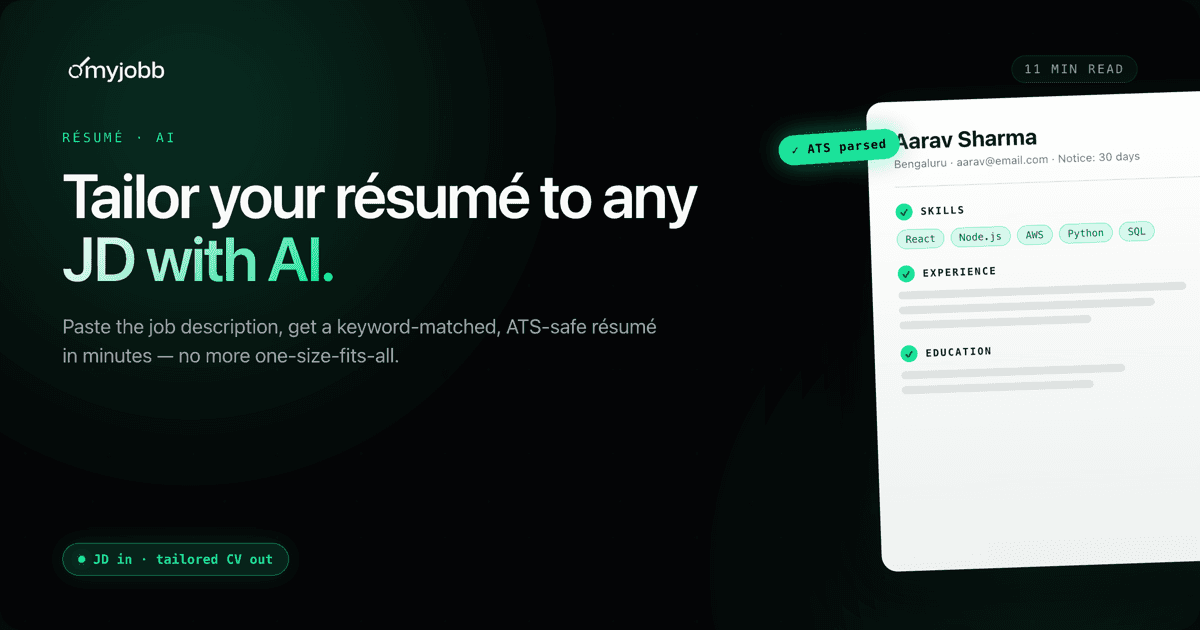
To tailor your resume to a job description, extract the JD's keywords, rewrite your top bullets in that exact language, quantify impact, and mirror the job title. The tailor resume to JD tool does this in 10-20 seconds; manually it takes 15-20 minutes.
myjobb is India's first AI job agent and a universal auto-apply agent: it applies on Naukri, Foundit, Hirist and Instahyre, and on career pages running Workday, Greenhouse, Ashby, Lever, Oracle Recruiting, SuccessFactors, iCIMS and other major ATS platforms. With myjobb, applying to a job is one click, and most applications happen automatically overnight.
This page is the guide: the full manual method, a worked before/after example for an Indian SDE role, and the honest lines you should never cross. The feature page above is the tool that runs the method for you on every application.
Why does a generic resume get rejected?
A generic resume fails the two filters between you and an interview call: the ATS keyword scan and the recruiter's few-second skim. It matches nothing in particular, so both filters pass on it. Recruiters search their ATS by the JD's exact terms, and a resume written for "any job" surfaces low in every search.
Filter 1: the ATS. Most mid-size and large employers in India parse your resume and score it against the specific JD. If the JD says "Spring Boot, microservices, AWS" and your resume says "backend development on cloud platforms," the parser finds no match. You may be exactly what they need. The software cannot tell.
Naukri adds its own layer. Your uploaded resume and Key Skills feed Resdex, the recruiter search database. Recruiters filter it by exact skill terms and designation.
Filter 2: the recruiter scan. A recruiter with hundreds of applicants gives each resume seconds. Does the headline match the role? Do the first three bullets sound like this job? Are CTC and notice period in range? Our breakdown of what recruiters look for in a resume in India shows how short that window is.
Job-title match alone is decisive. Jobscan's State of the Job Search research (2024) found resumes with the exact target job title were over 10 times more likely to get an interview. 55% of surveyed recruiters filter by job title in their ATS.
The fix is not a better generic resume. It is a slightly different resume for each role. We cover the failure mode in why a generic resume gets rejected in India. This guide is the repair manual.
How do you read a JD and pull the right keywords?
Read the JD once for context, then a second time extracting four categories: required skills, named tools, repeated phrases, and good-to-have skills. Every keyword you genuinely have should appear in your resume in the JD's exact words. The job description is an answer key; most applicants never treat it as one.
- Required skills. Anything after "must have," "required," "minimum qualifications." Every one you genuinely have must appear in your resume in the JD's exact words.
- Tools and technologies. Named software, languages, frameworks. ATS engines and Resdex searches weight these heavily. If the JD says "Kafka," write "Kafka," not "message queues."
- Repeated phrases. Any term used twice or more is being emphasised ("ownership," "0-to-1," "B2B SaaS"). Use it once, in context.
- Preferred / good-to-have skills. Partial matches still lift your score. Include the ones you honestly have.
Keyword-extraction mini-checklist
- [ ] Listed every "required" skill in the JD's exact wording
- [ ] Listed every named tool/technology (and both forms where common: "Search Engine Optimization (SEO)")
- [ ] Noted phrases repeated 2+ times
- [ ] Noted the exact job title and seniority ("SDE-2," "Senior Product Manager")
- [ ] Noted domain terms (fintech, quick commerce, BFSI, D2C)
- [ ] Struck out anything you cannot honestly claim
That last box matters most. Tailoring means describing what you actually did in the employer's vocabulary. Never add skills you don't have. For role-specific starting lists, see resume keywords for software engineers in India.
What is the 4-step method to tailor your resume to a job description?
Match keywords in your summary and skills section, reorder and rewrite your bullets, quantify everything, and mirror the job title. That is the whole tailoring method. It takes 15-20 minutes per application once practiced, 30-60 minutes when you are new to it, and 10-20 seconds with AI.
Step 1: Match your resume to the job description's keywords
Rewrite your 2-3 line summary to include the target job title and the two or three highest-priority keywords. Update your skills section to lead with the JD's exact terms, in the JD's order of priority. Keep it a flat, scannable list. No tables, star ratings or two-column layouts that confuse parsers.
Step 2: Reorder and rewrite your bullets
Work experience carries the most ATS weight because keywords appear there in context. Move your most JD-relevant bullets to the top of each role. Then rewrite your top 3-5 bullets in the JD's vocabulary. You're not changing what you did. You're changing how you describe it.
Step 3: Quantify everything you can
Numbers survive the recruiter scan: latency reduced, revenue influenced, users served, team size, ₹ budget managed. "Improved checkout performance" becomes "Cut checkout p95 latency 40% for 2M monthly users." Honest ranges beat adjectives.
Step 4: Mirror the job title
If your official title doesn't map to the JD's, add the standard equivalent as a clarifier: "Member of Technical Staff (Backend Software Engineer)." Indian startup titles are famously non-standard. "Growth Ninja" helps nobody's ATS score. Clarify honestly. Never claim a seniority you didn't hold.
Finish with a formatting pass. Keep it to 1 page for freshers, 2 pages for 5+ years. Keep CTC expectations and notice period out of the resume body. They belong in portal profile fields and screening questions, where recruiters actually filter on them. Full formatting rules are in our ATS resume format for India guide.
What does a tailored resume look like? Before and after for an Indian SDE role
Below is the same engineer's experience, first generic, then rewritten in the JD's vocabulary. The facts do not change. The language does. This is the output the 4-step method should produce, and the standard any AI resume tailoring tool should be judged against.
The JD (excerpt): "SDE-2 (Backend) at a Bengaluru fintech. Required: 3-5 years building microservices in Java/Spring Boot, REST APIs at scale, AWS, PostgreSQL, Kafka. Preferred: payments or lending domain, on-call ownership. You will own services end-to-end in a high-throughput UPI stack."
Keywords extracted: SDE-2, backend, microservices, Java/Spring Boot, REST APIs, AWS, PostgreSQL, Kafka, payments/UPI, ownership.
Before (generic bullets):
- Worked on backend systems for the payments team
- Developed APIs and fixed production bugs
- Used various cloud technologies for deployment
- Collaborated with team members on new features
After (tailored, same facts):
- Built and owned 6 Java/Spring Boot microservices in a UPI payments stack processing 1.2M transactions/day on AWS
- Designed REST APIs consumed by 4 internal teams; cut p99 latency from 480ms to 190ms by tuning PostgreSQL queries and adding Kafka-based async processing
- Led on-call for payment-settlement services; brought recurring reconciliation failures down 70% quarter-on-quarter
- Shipped 3 lending-integration features end-to-end, from design review to production rollout
Same engineer, same work history. The second version matches the JD's required-skills list nearly term for term. It quantifies impact and reads like it was written for this role, because it was.
Should you customise your resume for every job in India?
Yes, customise your resume for every job in India that you genuinely want. For exploratory applications, at minimum update your headline, summary and skills section. AI resume tailoring removes the trade-off entirely: when a per-job version takes 10-20 seconds, every application can be your best one.
Here is how the three approaches compare:
- Time per application. Manual tailoring: 15-20 min (30-60 when new) · ChatGPT prompting: 5-10 min + reformatting · Per-job AI tailoring (myjobb): 10-20 seconds
- Keyword extraction. Manual tailoring: You, with a highlighter · ChatGPT prompting: Decent, needs a good prompt · Per-job AI tailoring (myjobb): Automatic; ranks the JD's keywords
- Output format. Manual tailoring: Whatever your template is · ChatGPT prompting: Text you must re-format; export often breaks ATS parsing · Per-job AI tailoring (myjobb): LaTeX-rendered, single-column PDF built for ATS parsing
- Fabrication risk. Manual tailoring: Low (you know your history) · ChatGPT prompting: Real; LLMs pad and invent if unchecked · Per-job AI tailoring (myjobb): Rewrites only from your master profile; never fabricates
- Submits the application. Manual tailoring: No, you fill every form · ChatGPT prompting: No, you fill every form · Per-job AI tailoring (myjobb): Yes, one click, or automatically overnight
Manual tailoring is the right way to learn the skill. It's worth it for the 2-3 roles you want most.
ChatGPT is a genuine speed-up. We've published a ready-made ChatGPT prompt to tailor your resume for Indian JDs. But you still own formatting, ATS-safe export, and fact-checking every line, and the output is text, not a submitted application. The full head-to-head is in AI resume builder vs ChatGPT.
The failure mode for both is volume. Applying seriously in India means 10-20 applications a week across Naukri, LinkedIn, Foundit, Hirist and Instahyre. Nobody hand-tailors at that rate. That's when people quietly go back to the generic resume, and back to silence.
How does myjobb tailor your resume to the JD automatically?
myjobb keeps one master profile and generates a fresh, ATS-checked resume for every job in 10-20 seconds. Pick a job from your ranked feed or paste any JD into the tailor resume to JD tool. You review the output, then apply with one click.
You import your PDF resume or LinkedIn URL once. For every job, the agent then:
- Ranks the keywords that JD scans for and rewrites your bullets around them: quantified, action-verb-led, and only ever from facts in your profile. It never fabricates.
- Renders a LaTeX PDF: single column, selectable text, standard fonts, tested against 16 ATS engines. No broken parsing from a Word export.
- Scores it with a built-in ATS checker on keyword coverage, quantified bullets, action verbs and structure, so you see what changed and why. Plain-English edits re-render in about 7 seconds. The format guarantees are covered on the AI resume builder page.
- Links the resume permanently to that job. When the recruiter calls two weeks later, you can pull up exactly what they saw.
There is no free plan, but new accounts get 20 free applications once, no card needed. After that, Starter is ₹499/month for 150 applications, Pro ₹999/month for 350 and Max ₹1,999/month for 1,000. Details are on the pricing page.
Where can you apply with the tailored resume in one click?
myjobb auto-applies on Naukri, Foundit, Hirist and Instahyre, and on company career pages running Workday, Greenhouse, Ashby, Lever, Oracle Recruiting, SuccessFactors, iCIMS and other major ATS platforms. LinkedIn jobs appear in your ranked feed and you apply with one click; LinkedIn auto-apply is on the roadmap, not live.
- Naukri, Foundit, Hirist, Instahyre. Auto-apply supported: Yes
- Workday, Greenhouse, Ashby, Lever career pages. Auto-apply supported: Yes
- Oracle Recruiting, SuccessFactors, iCIMS. Auto-apply supported: Yes
- LinkedIn. Auto-apply supported: Ranked feed with one-click apply; auto-apply on roadmap
Every application the auto-apply agent submits overnight goes out with a resume tailored to that specific JD, through your own logged-in session. CTC and notice period fields fill correctly from your profile, and you wake up to a 9:00 AM IST report of every application. Compare that with the manual grind: a new Workday account per company and the same 30-minute form each time. For the full workflow, see how to automate your job hunt in India.
What are the do's and don'ts of resume tailoring?
Tailor honestly and format simply. Use the JD's exact vocabulary for real experience, quantify with defensible numbers, and keep the layout single-column and parseable. Never invent skills, inflate titles, or stuff keywords. The table below covers the lines you should never cross.
- Use the JD's exact terms ("Spring Boot," not "Java frameworks"). Don't: Stuff keywords into white text or a hidden list; modern ATS flags it, recruiters blacklist it
- Rewrite how you describe real experience. Don't: Invent skills, titles, CGPAs or employers; background checks in India are routine
- Quantify with numbers, ₹, %, scale. Don't: Claim metrics you can't defend in the interview
- Keep one master resume, tailor a copy per job. Don't: Overwrite your only copy for every application
- Mirror the JD's job title honestly. Don't: Promote yourself from SDE-1 to SDE-3 on paper
- Keep formatting single-column and parseable. Don't: Ship a designer template with icons, columns, star ratings and graphics
FAQ
How do I tailor my resume to a job description?
Extract the JD's required skills, named tools, and repeated phrases. Rewrite your summary and top bullets in that exact language, quantify your impact, and mirror the target job title. Check the result against the JD before applying, and cut bullets that are irrelevant to this specific role.
Is it worth tailoring your resume to each job?
Yes, for any role you actually want. Jobscan's 2024 research found resumes with the exact target job title were over 10 times more likely to get an interview. Tailoring is the highest-leverage 15 minutes in a job application, and AI tools cut that to seconds.
How long does it take to tailor a resume?
Manually, 15-20 minutes per application once you have a strong master resume, and 30-60 minutes when you're new to it. ChatGPT prompting cuts it to 5-10 minutes plus reformatting. Per-job AI tailoring tools like myjobb generate an ATS-ready version in 10-20 seconds, which you then review.
Can AI tailor my resume and apply to the job for me?
Yes. myjobb tailors a resume to each JD in 10-20 seconds, then auto-applies on Naukri, Foundit, Hirist and Instahyre, and on career pages running Workday, Greenhouse, Lever and other major ATS platforms. LinkedIn jobs appear in the feed for one-click apply; LinkedIn auto-apply is on the roadmap.
Can employers tell if you used AI to write your resume?
Not reliably, and most don't care if the content is true and specific. What gets AI-assisted resumes rejected is generic output: buzzword summaries, vague achievements, no connection to the JD. The line is fabrication, not assistance. Tailor real experience with AI and review it in your own voice.
How many versions of my resume should I keep?
One master resume plus one tailored copy per application. The master holds every role, project and metric you could use; each tailored copy picks the relevant parts and mirrors that JD's wording. Save the exact version you sent, so you can prepare from it when the recruiter calls.
Is tailoring a resume the same as lying?
No, as long as every claim stays true. Tailoring changes emphasis and wording: which projects lead, which skills you name first, whether you say "REST APIs" or "microservices" to match the JD. Adding a tool you have never used or inflating a title is fabrication, and it usually falls apart in the interview.
Tailoring works. The only reason most applicants skip it is time, and that's now a solved problem. Paste one JD into the tailor resume to JD tool, get an ATS-checked, JD-matched resume in about 20 seconds, and send it with one click. New accounts get 20 free applications to try it.