
Running a job search while working full time comes down to three things. Lock down your privacy settings on Naukri and LinkedIn so your employer never sees you. Batch or automate applications so the search fits into 2-3 hours a week. And handle interviews with leave tactics that raise no eyebrows.
This guide covers each step with India-specific detail: Naukri privacy settings, recruiter-only LinkedIn visibility, and automation that applies while you sleep.
Can you job search while working full time?
Yes, and you should. Recruiters often prefer employed candidates because their skills are current and their track record is live. The real challenges are time and secrecy, and both are solvable.
The fear is real. Your manager finds your Naukri profile marked "active today". A colleague spots your LinkedIn banner. HR notices three "doctor appointments" in two weeks. Every one of these leaks has a specific fix, covered below.
One mindset shift first. A discreet job search india professionals can sustain is a slow, steady one. You are not unemployed and desperate. You can afford to apply only to strong matches and wait for the right offer.
How do you keep your job search confidential on Naukri?
Block your current employer under Settings, then Blocked Companies, so its recruiters cannot view your profile. Naukri also blocks your current company by default based on your listed employer. For full stealth, you can turn off recruiter visibility entirely and still apply to jobs.
Here is the exact confidential job search naukri setup, step by step:
- Log in to Naukri and open Settings from your profile menu.
- Open the Blocked Companies section.
- Search and add your current employer. Add group companies and sister brands too.
- Add your company's staffing partners if you know them. Agencies talk.
- Check your listed current employer is spelled correctly. The default block keys off this field.
- Optional: in Communication and Privacy, set recruiter emails to off. Your profile stops appearing in recruiter database searches, but you can still search and apply.
Two caveats. Naukri's own FAQ says the block is best effort, not guaranteed. And blocking has a cost: naukri privacy settings recruiter visibility works both ways. A fully hidden profile gets zero inbound recruiter calls. Blocking just your employer is the better trade for most people.
Keep your resume file clean too. Remove your personal blog or portfolio if it names your current team's confidential projects.
Can your employer see you on LinkedIn if you use Open to Work?
Not if you choose "Recruiters only". LinkedIn hides your Open to Work signal from recruiter accounts linked to your current company. There is no green photo frame, and colleagues see nothing. LinkedIn says the block is not 100% guaranteed, but it holds for most cases.
Set it up in two minutes:
- On your profile, tap Open To, then Finding a new job.
- Choose titles, locations, and start date.
- Under visibility, pick "Recruiters only". Never pick "All LinkedIn members" while employed.
- Before editing your profile, turn off "Share profile updates with your network" in Settings. Otherwise every headline tweak gets broadcast.
The residual risk: third-party agency recruiters hired by your employer may still see the flag. Keep your headline neutral. "Product Manager at Meesho" is fine. "Seeking new opportunities" is a confession.
Naukri vs LinkedIn: privacy settings compared
- Hide from current employer. Naukri: Blocked Companies list, plus default block on listed employer · LinkedIn: Open to Work set to "Recruiters only"
- Hide from all recruiters. Naukri: Turn off recruiter communication, profile leaves database searches · LinkedIn: Skip Open to Work entirely
- Silent profile edits. Naukri: Edits are not broadcast to a network · LinkedIn: Turn off "Share profile updates" first
- Guarantee. Naukri: Best effort, per Naukri's FAQ · LinkedIn: Not guaranteed for agency recruiters
- Cost of hiding fully. Naukri: No inbound recruiter calls · LinkedIn: Fewer recruiter InMails
On Foundit, Instahyre, and Hirist, review each account's visibility or communication settings before uploading a resume. Portals differ, so check what recruiters can search before you go live.
How do you manage time for a job search while working full time?
Reserve 2-3 hours a week and batch everything, a cadence recommended by Harvard Business Review (2023). Batch job discovery into one sitting, applications into another, and follow-ups into a third. Or hand the repetitive part to automation and spend your hours on interviews instead.
A sustainable weekly rhythm for looking for job while employed:
- Mon, Wed lunch. Time (IST): 20 min · Task: Shortlist matched jobs, save the best
- Tue or Thu evening. Time (IST): 45 min · Task: Tailor resumes, apply to shortlist
- Sat morning. Time (IST): 60 min · Task: Referral messages, recruiter follow-ups
- Sun evening. Time (IST): 15 min · Task: Plan the week, prep any scheduled calls
Never do any of this on the office laptop or company WiFi. Indeed's Career Guide (2026) is blunt on this: personal phone, personal data plan, personal email, always. Assume the IT team can see everything on the corporate network.
Can AI apply to jobs for you while you work?
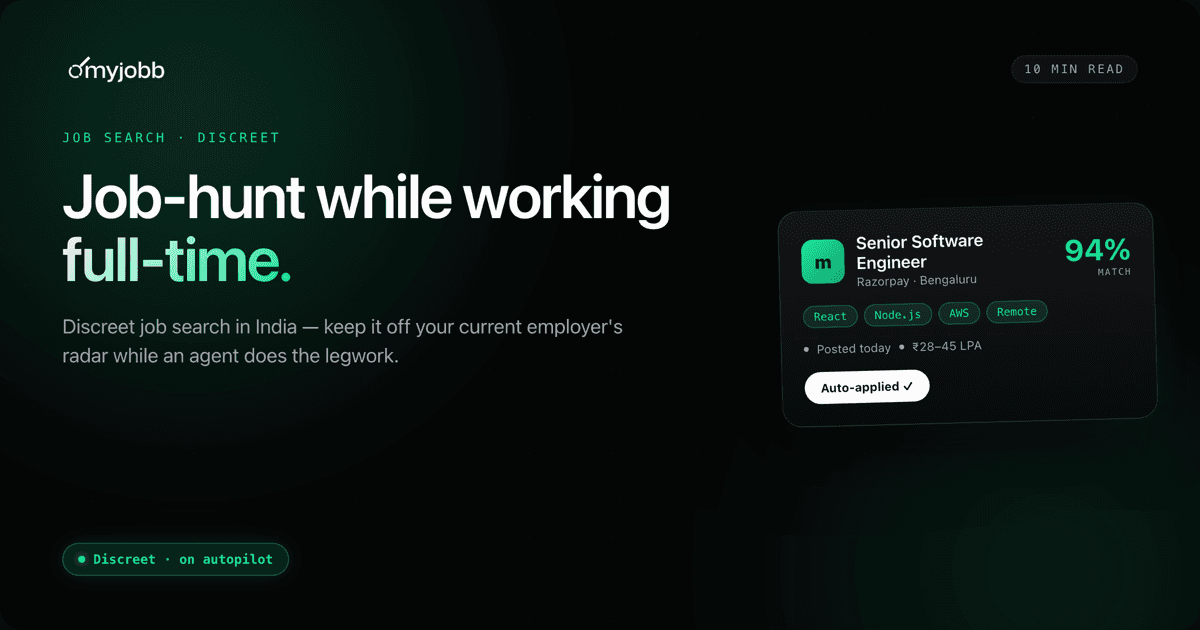
Yes. myjobb's auto-apply agent reads 50K+ new jobs daily across Naukri, Foundit, Hirist, Instahyre, and LinkedIn, ranks them against your resume, and auto-applies overnight on Naukri, Foundit, Hirist and Instahyre through your own logged-in portal sessions. LinkedIn jobs show up in the feed for you to apply to yourself. You set the rules: a daily cap of 1-25, a match score floor, and companies to exclude, including your current employer and its group brands.
This matters for a job hunt without current employer knowing. Applications go through your own session, so they look identical to manual ones. Recruiters cannot tell an agent applied. If a screening question needs your judgment, the run pauses and asks you instead of guessing. Your 9:00 AM IST report shows every application and answer.
Each application also gets a resume tailored to that JD in 10-20 seconds. That is the tailoring step most employed job seekers skip at 11 PM. See how the pieces fit in our guide to automating your job hunt in India, and read how auto apply works safely on Naukri if account safety worries you.
Not sure how many applications is enough? Our data-backed take on how many jobs to apply to per day in India covers quality vs volume.
How do you interview around work without raising suspicion?
Ask for calls before 10 AM, over lunch, or after 6:30 PM IST, and say upfront that you need discretion. Most Indian recruiters handle employed candidates daily and will accommodate you. For onsite rounds, take planned leave, never a fake sick day.
Tactics that work in Indian companies:
- Request virtual first rounds. Take them from home, your car, or a booked meeting room, never your desk.
- Cluster interviews. One casual leave covering two interviews beats two suspicious half days.
- Avoid the 9 AM "doctor appointment" pattern. Repetition is what gets noticed.
- Do not wear formals to a jeans office. Change on the way if the interviewer expects business dress.
- Know your notice period and current CTC before the call. Fumbling those numbers on a hallway call is how people get overheard.
- If asked why you are leaving, stay neutral: growth, learning, ownership. Never criticize your employer mid-search.
How do you avoid tipping off colleagues?
Tell no one at work, not even your work best friend. TopResume's career advice (2024) calls this out directly: telling one colleague is telling all of them. Most discreet searches leak through casual conversation, not software.
The full quiet checklist:
- No colleagues or current manager as references. Use previous employers and warn them in advance.
- No hints on social media. No "exciting news soon" posts.
- No sudden disengagement at work. Keep delivering, keep your standup updates normal.
- No printouts of resumes or offer letters on office printers.
- Keep recruiter calls off WhatsApp groups synced to your work phone.
If your manager does find out, do not panic or lie badly. Say you stay open to learning about the market, then keep performing. In most Indian companies, exploring is not a fireable offense. Underperforming while exploring is what burns bridges.
What is the fastest discreet route to an offer?
Fewer, better applications plus referrals. A hidden search cannot rely on recruiter inbound, so precision matters more. Target 8-10 tailored applications a week, add a referral wherever you can, and let automation keep the pipeline full while you work.
That pace, held for six to eight weeks, typically fills an interview calendar without a single late night. For the broader playbook, see how to find a job in India fast in 2026.
Want the grind handled while you focus on interviews? myjobb applies to strong matches overnight through your own portal logins, skips your current employer, and reports every morning at 9 AM IST. New accounts get 20 free applications, no credit card needed.
FAQ
Can my current employer see my profile on Naukri?
By default, no. Naukri blocks the company you list as your current employer from viewing your profile. For safety, also add your employer and its group companies under Settings, then Blocked Companies. Naukri's FAQ notes the block is best effort, so keep your listed employer name accurate and spelled correctly.
Can recruiters from my own company see I am Open to Work on LinkedIn?
Not usually. With "Recruiters only" selected, LinkedIn hides your Open to Work status from recruiter accounts associated with your current employer. LinkedIn says it cannot fully guarantee this, since third-party agency recruiters working for your company may still see it. Regular colleagues and connections see nothing either way.
How do I hide my resume from my current employer on Naukri?
Open Settings from your profile menu, select Blocked Companies, then search and add your current employer. Recruiters from blocked companies cannot view your profile or resume. Add sister companies and known staffing partners too. For maximum privacy, disable recruiter communication entirely; you can still search and apply to jobs normally.
Is it better to look for a job while employed?
Generally, yes. Recruiters view employed candidates as lower risk because their skills and track record are current. You also negotiate from strength, since you can decline weak offers without pressure. The tradeoff is time and secrecy, which batching, privacy settings, and application automation largely solve for working professionals.
How much time should I spend job searching while working full time?
Reserve at least 2-3 hours per week, the floor recommended by Harvard Business Review (2023). Split it across shortlisting, applying, and follow-ups rather than one exhausting sitting. Around 8-10 tailored applications weekly is a sustainable pace. Automation tools can handle the applying step, freeing your hours for interview preparation.
Should I tell my manager I am looking for a new job?
No, not until you have a signed offer in hand. Telling your manager early can cost you projects, appraisal goodwill or your job, with nothing gained if the search takes months. Resign only after the written offer, and keep your current work steady until then.
Can I use my office laptop or work email to apply for jobs?
No, keep every part of the search on personal devices and a personal email. Company laptops, VPNs and mail are often monitored, and your resume or interview invites sitting there are easy to find. Take screening calls from your own phone, away from your desk.
How do I handle reference checks when my employer does not know I am searching?
Give references from past managers or ex-colleagues who have left, and ask the new company whether the check with your current employer can wait until after you accept the offer. Warn each reference before you share their number so they pick up.